

Most of the "shot tracking hardware" conversation focuses on a single product going head-to-head with another single product. That misses the bigger difference here. Golf Pad doesn't force every golfer into the same method. You can track manually in the free app, tap a TAGS chip on your club before each shot, click a physical button on your belt or cap, or track from an Apple Watch, Wear OS watch, or Samsung Galaxy Watch, and switch between them round to round depending on your mood or your bag setup. Arccos offers one hardware approach per purchase: sensors screwed into every grip plus a phone in your pocket, or the newer Air wearable that skips sensors entirely but trades that convenience for guesswork on which club you used.
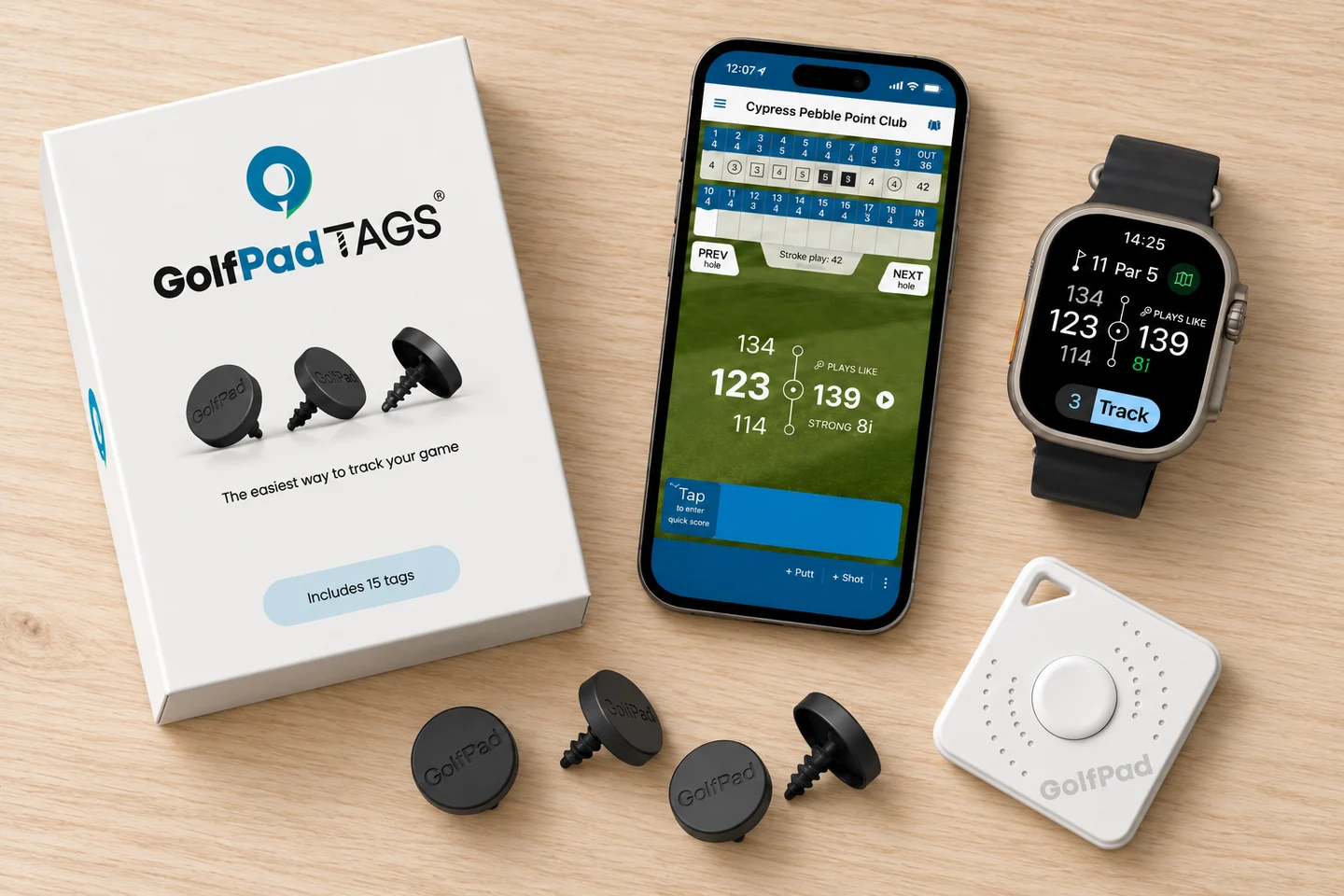
If you already know you want the simplest, most foolproof method, that's one conversation. If you're not sure yet whether you'd rather tap a tag, click a button, or just use your watch, Golf Pad is the only one of the two that lets you actually try more than one answer without buying a second hardware system.
Golf Pad TAGS are NFC chips, one per club, that you tap your phone against right before you hit. Because you're physically tapping the chip that lives on that specific club, the app always knows exactly which club you used. There's no inference involved and nothing for software to guess at. The tags have no batteries, add about 1.9 grams of weight, and the $119 kit includes 15 tags plus a year of Golf Pad Premium.
Arccos currently sells two different hardware approaches, and they land in very different places on reliability:
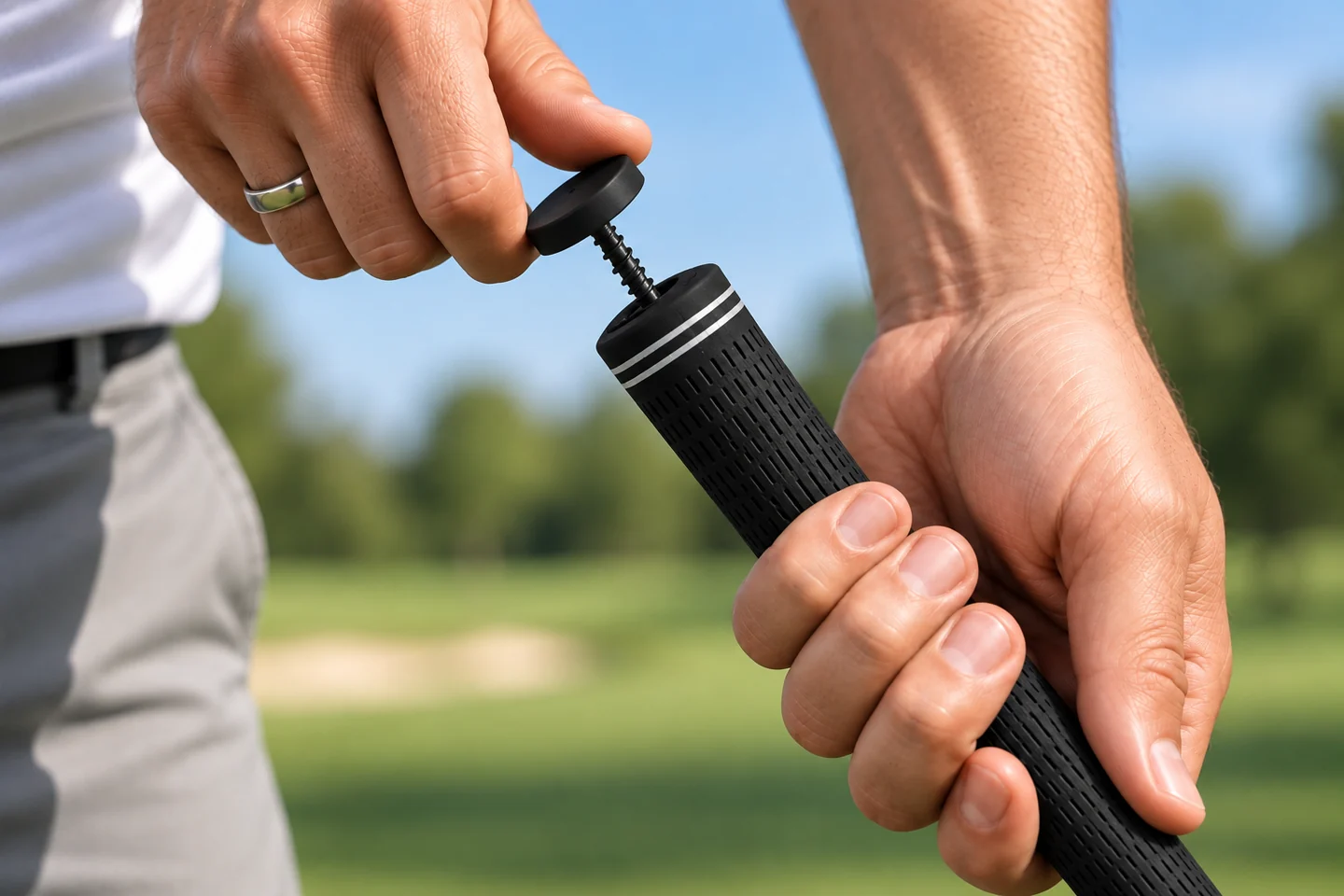
Arccos Smart Sensors + Caddie Link ($179.99 to $199.99 for sensors, plus $129.99 for the optional Link, commonly around $300 combined) screw into each club's grip and require your phone in your pocket during the round to log shots via Bluetooth and impact sound. Independent reviews of the current Gen 3+ sensors with Link report strong accuracy with minimal editing needed beyond adding penalty strokes. Older-generation reviews, and some current ones, describe a more persistent issue: the putter sensor in particular can miss or misread putts because of low impact noise, which means manually checking your recorded score against your actual scorecard after the round.
Arccos Air ($349.99 including the first year, $199.99 a year after) is Arccos's newer, sensorless option: no club sensors, no phone needed during the round, just a small wearable that syncs afterward. The tradeoff is club identification. Without sensors, Air uses AI to infer which club you likely hit based on distance and shot pattern, and one detailed reviewer who tracked accuracy directly found it correctly identified the club about 60 to 70% of the time, meaning 30 to 40% of shots needed manual correction. Arccos itself recommends checking results every few holes rather than waiting until the round is over, which is a meaningful amount of upkeep for a product marketed as "no sensors, no phone, just golf."
| Golf Pad TAGS | Arccos Smart Sensors + Link | Arccos Air | |
|---|---|---|---|
| Hardware cost | $119 (15 tags, no batteries) | About $300 (sensors + Link) | $349.99 |
| First year included | 1 year Golf Pad Premium ($29.99 value) | 1 year membership included | 1 year game tracking included |
| Ongoing subscription | Not required for TAGS to keep working | $99/year after year one | $199.99/year after year one |
| Phone needed during round | Only to tap the tag before a shot | Yes, in your pocket | No |
| Club identification | Always exact, tap confirms the club | Sensor-confirmed, generally reliable on current generation | AI-inferred, roughly 60 to 70% accurate without added sensors |
| Typical post-round editing | Minimal | Varies by generation; putting misses reported on some units | Meaningful; reviewers recommend checking every few holes |
| Other tracking methods from the same brand | Manual, Click button, smartwatch | Apple Watch companion app | Optional add-on club sensors, at extra cost |
Run the numbers over three seasons and the gap widens rather than closes: Golf Pad TAGS is a single $119 purchase with no required renewal, while Arccos Smart Sensors run close to $500 and Arccos Air closer to $750 over the same three years once the subscription renews twice.
If you want a tracking method that never requires you to double-check its work, TAGS' tap-to-confirm design means the club is never in question, only your own consistency in tapping before each shot. If you'd rather not touch your phone at all, Golf Pad Click covers that for $39.99 without any of Arccos's AI guesswork. If you're the kind of golfer who's happy to spend a few seconds every few holes correcting a club, Arccos Air's phone-free convenience might be worth that tradeoff to you. What's hard to justify is paying roughly two to six times more for a system that, in the sensorless configuration at least, still needs you to check its work.
How much does Golf Pad TAGS cost compared to Arccos?
Golf Pad TAGS is $119 one-time, including 15 tags and a year of Premium. Arccos Smart Sensors with Caddie Link run about $300 to start plus $99 a year afterward, and Arccos Air is $349.99 to start plus $199.99 a year afterward.
Does Golf Pad TAGS require a subscription?
No. The $119 kit includes a year of Premium, but TAGS itself continues to log shots and clubs whether or not you renew Premium afterward.
Is Arccos Air accurate without club sensors?
Its shot detection is strong, but club identification is AI-inferred rather than confirmed by a sensor, and independent testing has found accuracy in the 60 to 70% range, meaning a meaningful share of shots need manual club correction after the round.
Why is Golf Pad TAGS considered more reliable for club data?
Because you tap your phone to the specific tag on the club you're about to use, the app always records the correct club. There's no AI inference involved, so there's nothing to get wrong.
What other ways can I track shots with Golf Pad besides TAGS?
Manual tracking in the free app, the Golf Pad Click Bluetooth button for one-click hands-free tracking, and smartwatch tracking on Apple Watch, Wear OS, or Samsung Galaxy Watch. Arccos's tracking options are tied to whichever hardware line you purchase.
Does Arccos work with Android smartwatches?
Arccos offers an Apple Watch companion app. Golf Pad supports Apple Watch, Wear OS, and Samsung Galaxy Watch, giving Android smartwatch owners an option Arccos doesn't clearly offer.


Subscribe for early access to promotions, feature announcements & more.

