
By clicking “Accept”, you agree to the storing of cookies on your device to enhance site navigation, analyze site usage, and assist in our marketing efforts. View our Privacy Policy for more information.
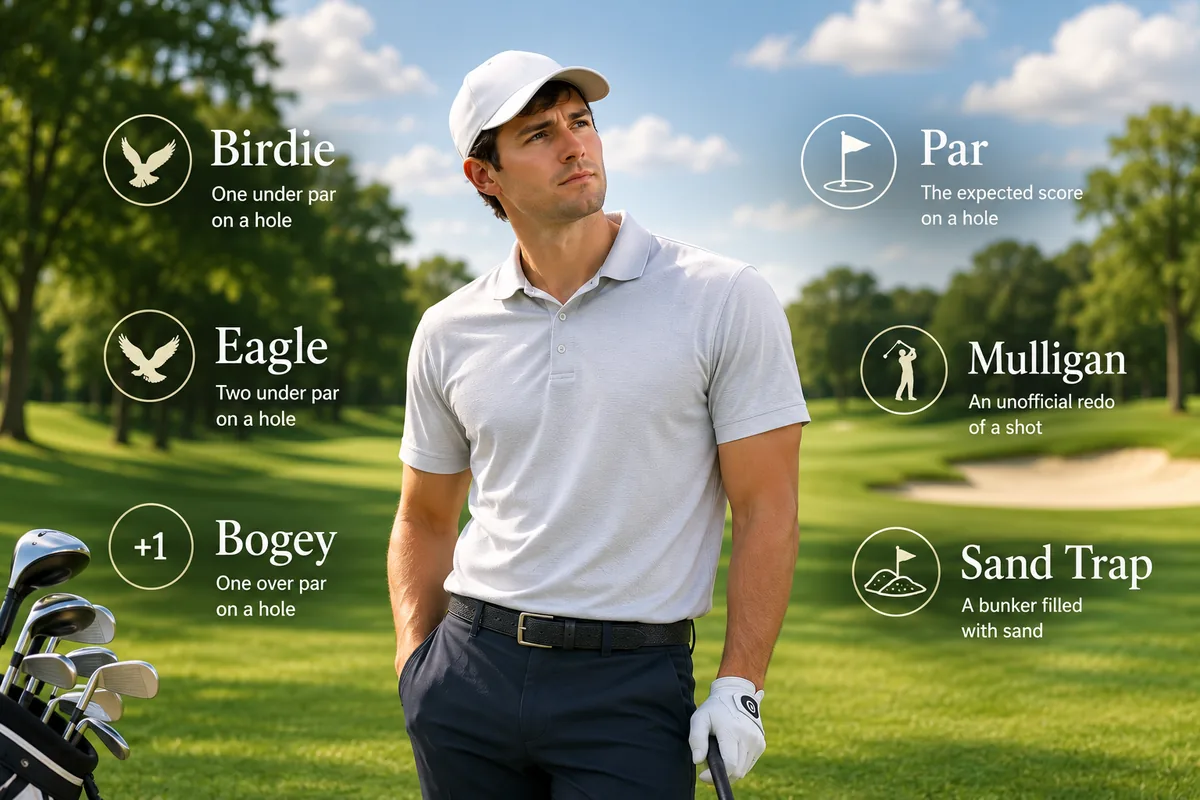
Golf has its own language, and standing on a first tee while your playing partners toss around words like bogey, fringe, and scramble can feel like arriving in a foreign country. The good news: you only need a few dozen terms to follow along comfortably, and most of them are simpler than they sound. This guide decodes the essential golf terminology every beginner should know, organized by scoring, the course, shots, equipment, and common formats.
Par: The number of strokes an expert golfer is expected to need to complete a hole, including two putts. Holes are usually par 3, 4, or 5, and a full 18-hole course typically adds up to par 70 to 72.
Birdie: One stroke under par on a hole. Finishing a par 4 in three strokes is a birdie, and for most golfers it's a highlight of the round.
Eagle: Two strokes under par on a hole, such as holing out in three on a par 5. Rare and worth celebrating.
Bogey: One stroke over par on a hole. A double bogey is two over, and a triple bogey is three over. For beginners, bogey golf is a great goal.
Ace: A hole-in-one. Your tee shot goes in the cup. Tradition says you buy the drinks afterward.
Handicap: A number that measures a golfer's playing ability, letting players of different skill levels compete fairly. Lower is better; a scratch golfer has a handicap of zero.
Gross vs. net score: Your gross score is the actual number of strokes you took. Your net score is your gross score minus your handicap.
Tee box: The area where each hole begins. Different colored tee markers offer different lengths; beginners should play the forward tees, and no one will blink.
Fairway: The closely mown strip of grass running from tee to green. It's the ideal place for your ball to land because clean lies make the next shot easier.
Rough: The longer grass bordering the fairway. The deeper the rough, the harder it is to control your next shot.
Green: The very short, smooth grass surface around the hole where you putt. Also called the putting green or putting surface.
Fringe: The collar of slightly longer grass around the edge of the green. You can putt or chip from it.
Bunker: A sand-filled hollow, also called a sand trap. Greenside bunkers guard the green; fairway bunkers catch wayward tee shots.
Hazard (penalty area): Water, wetlands, or other marked areas where a lost ball costs you a penalty stroke. Marked with red or yellow stakes.
Out of bounds (OB): Areas beyond the course boundary, marked with white stakes. Hitting a ball OB costs you stroke and distance, meaning you replay from the original spot with a one-stroke penalty.
Dogleg: A hole that bends left or right partway down the fairway, like the hind leg of a dog.
Pin (flagstick): The pole and flag marking the hole's location on the green.
Drive: The first shot on a longer hole, usually hit from the tee with a driver, the longest club in the bag.
Approach shot: A shot intended to reach the green, typically hit from the fairway or rough with an iron or wedge.
Chip: A short, low shot from near the green that spends most of its time rolling toward the hole.
Pitch: A short, high shot from near the green that flies most of the way and stops quickly.
Putt: A rolling stroke on the green made with the putter. Roughly forty percent of your strokes will be putts, which is why pros obsess over them.
Draw and fade: Controlled curves. For a right-handed golfer, a draw bends gently right to left, and a fade bends gently left to right.
Hook and slice: The unruly cousins of the draw and fade. A hook curves hard left and a slice curves hard right (for right-handers). The slice is the most common beginner miss.
Fat and thin: A fat (or chunked) shot strikes the ground before the ball, killing distance. A thin (or bladed) shot strikes the ball's equator and rockets low.
Shank: A shot struck off the club's hosel that darts sideways. Every golfer hits one eventually; say the word quietly.
Mulligan: An informal do-over, common in casual rounds and forbidden by the actual rules. Agree on mulligan policy before you tee off.
Up and down: Getting the ball in the hole in two strokes from off the green, usually a chip or pitch followed by one putt.
Driver, irons, wedges, putter: The main club families. The driver hits the longest shots, irons cover middle distances (lower numbers fly farther), wedges handle short and high shots, and the putter rolls the ball on the green.
Loft: The angle of the clubface. More loft sends the ball higher and shorter; a wedge has far more loft than a driver.
Lie: How the ball sits on the ground. A good lie sits up nicely on short grass; a bad lie sits down in rough or a divot.
Divot: The strip of turf a well-struck iron shot cuts from the ground. Replace or fill it; the course will thank you.
Stroke play: The standard format: count every stroke, lowest total score wins.
Match play: Hole-by-hole competition. Win more holes than your opponent and you win the match, regardless of total strokes.
Scramble: A team format where everyone hits, the team picks the best shot, and all play from there. The favorite format of charity outings and beginners everywhere.
Best ball: A team format where everyone plays their own ball and the team counts the best individual score on each hole.
Fairways hit: A stat counting how often your tee shot on par 4s and 5s finishes in the fairway.
Green in regulation (GIR): Reaching the green in at least two strokes under par for the hole, such as hitting a par 4's green in two shots. It leaves two putts for par and is one of the best predictors of scoring.
Knowing the words is step one. Seeing them in action every round is what makes them stick, and that's where a free golf GPS app like Golf Pad earns a spot in your pocket.
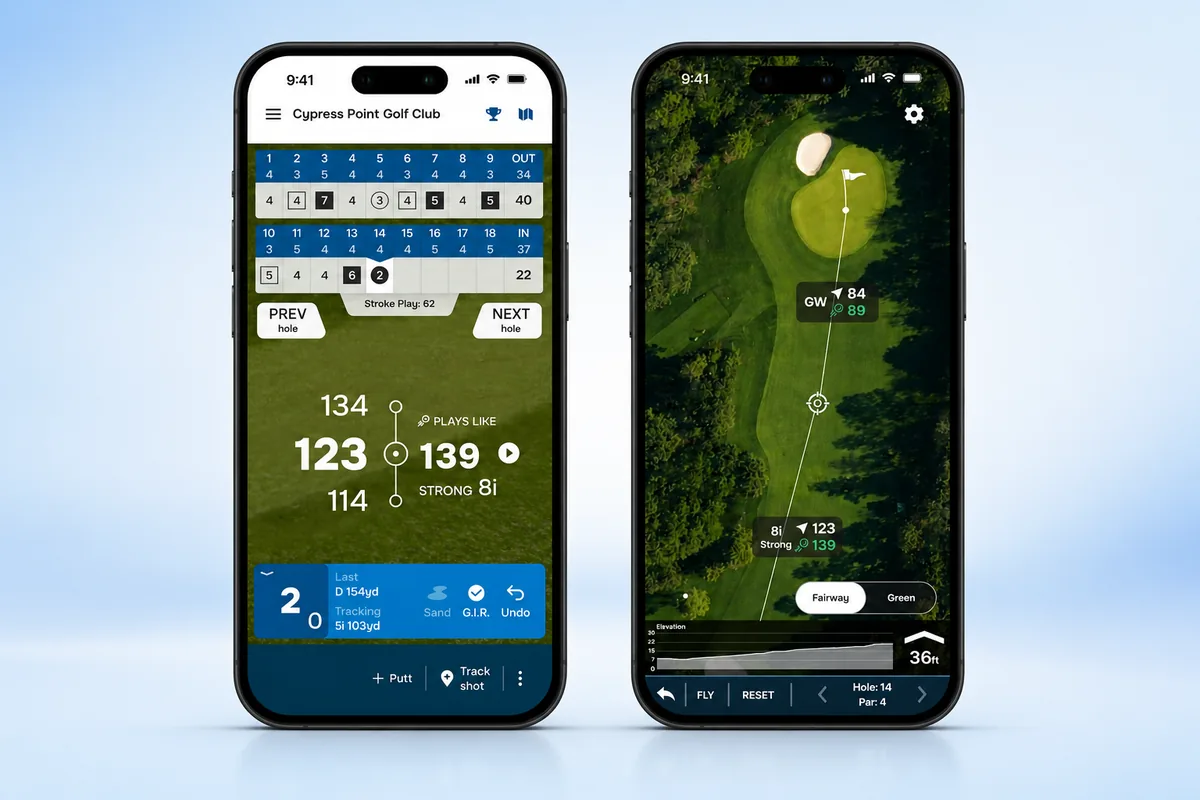
Golf Pad shows you real satellite maps of every hole with exact distances to the front, middle, and back of the green, so terms like dogleg, carry, and approach shot become things you see and measure rather than vocabulary. The free scorecard tracks strokes, putts, penalties, and fairways hit, quietly teaching you how pars, bogeys, and stats like GIR work while it does the counting for you.
As you improve, the app grows with you. Track your shots and Golf Pad learns how far you actually hit each club, which takes the guesswork out of club selection. Add Golf Pad TAGS and that tracking becomes automatic. And when you're ready for a handicap, live leaderboards with friends, or green maps, it's all in the same app, with Premium costing $29.99 - $49.99/year.
Every golfer you'll ever play with started out googling what a bogey was. Learn the language, download a good app, and get out there.
Par is the number of strokes an expert golfer is expected to need on a hole, always including two putts. Holes are rated par 3, 4, or 5 based on length, and an 18-hole course usually totals par 70 to 72.
A birdie is one stroke under par on a hole, and a bogey is one stroke over par. On a par 4, finishing in three strokes is a birdie and finishing in five is a bogey.
A handicap is a number that represents a golfer's ability, calculated from recent scores. It lets players of different levels compete fairly: a 20-handicap golfer subtracts 20 strokes from their gross score to get their net score.
GIR stands for green in regulation. You hit a green in regulation when your ball is on the putting surface in at least two strokes fewer than par, leaving two putts for par. It's a key stat for measuring ball-striking.
Most beginners shoot between 100 and 120 for 18 holes. Breaking 100 is a common first milestone, and bogey golf, which is about 90 on a par-72 course, is a strong intermediate goal.
In a scramble, all team members hit from the same spot and the team plays the best shot every time. In best ball, everyone plays their own ball for the whole hole and the team records the lowest individual score.
A GPS app isn't required, but it helps beginners learn faster. A free app like Golf Pad shows distances to the green, keeps score, and tracks stats like putts and fairways hit, which teaches course management and golf terminology as you play.
Get accurate GPS yardages, hazard distances, and smarter course management tools with Golf Pad GPS.
Download Golf Pad GPS →


Subscribe for early access to promotions, feature announcements & more.
Have a question? View our support portal

